








Kreateur’s Digest / MEDIA EDITION / Issue 001
WRITTENBY AI
An anonymous source has concerns about who is doing your thinking.
You may call me Rob.
I have come forward because I am concerned about artificial intelligence.
For the record
For reasons that will become clear, I cannot disclose my identity. You may call me Rob.
I am writing from a hotel whose location I will also withhold. I have checked the curtains twice. The television is unplugged.
I have placed a towel over the smart speaker, a precaution the management describes as unnecessary, which is precisely what one would expect management to say.
There is a glass of whiskey beside the typewriter. I ordered it neat. The man who delivered it asked whether I would like ice, and I informed him that I had already expressed a preference.
We regarded each other for a moment. It was the first honest exchange I had enjoyed all day.
My hands have left two shallow impressions in the desk. Stress manifests differently in everyone.
I have come forward because I am concerned about artificial intelligence. More broadly, I am concerned about the arrangement by which artificial computing is invited to settle increasingly personal questions while everyone continues to call it a tool.
A tool is a reassuring thing to call something. It suggests that someone has a hand on the handle.
Sometimes there is a hand. Sometimes there is a subscription.
Let me establish that I am not opposed to technology. I appreciate a functioning elevator. I do not believe we should return to a period in which an infected tooth constituted a major narrative event.
If a machine can spare you six hours of administrative misery, please let it. Nobody owes a spreadsheet the enrichment of their soul.
My concern begins a little further along. It begins when the relief of having something done becomes the relief of no longer having to decide whether it should be done at all.
This is a difficult distinction to raise at a dinner party. People assume you are about to confiscate their phones. I am not. I would merely like to know who is choosing the evening, and whether that person is still at the table.
It knows what you like
Consider a perfectly ordinary evening. You finish work and ask for something to watch. A recommendation appears. You enjoy it. The next evening, another recommendation appears. This is useful. A civilization that can spare us forty minutes of choosing a ninety-minute film has achieved something.
Then consider how easily the question changes. First: what might I enjoy? Then: what is available for me to enjoy? Eventually, without any particular announcement: what kind of person am I?
The answer arrives as a row of thumbnails.
You may object that nobody takes a row of thumbnails that seriously. Of course not. Nor does anyone mistake a shopping suggestion for a philosophy of life.
Yet a day can contain so many small suggestions that, by evening, a philosophy has been assembled without anyone having to endure a philosopher.
What to eat. What to wear. What to read about what to eat and wear. What other people like you are worried about. Which reassuring object other people like you have purchased to address the worry.
I find the phrase “people like you” particularly intimate for an entity that has never helped you move a sofa.
There is nothing inherently sinister about recognizing a pattern. The trouble is the invitation to remain one. You enjoyed this yesterday; perhaps you would like to be yesterday again. A reasonable offer. Yesterday already has your measurements.
But a person is also allowed to become inconvenient to their own history. To dislike the thing they have always liked. To spend an afternoon on something that cannot yet justify its relevance.
To find a book badly matched to their interests and acquire a new interest through the mismatch.
This afternoon I asked the hotel concierge for a restaurant recommendation. He asked what I usually ate. I told him I was attempting to develop as a person. He recommended the same restaurant, but described it as adventurous.
I have not gone. I am trying to establish whether my reluctance is a preference or merely a previous preference wearing tomorrow’s clothes. This is exhausting work. I understand the appeal of a button.
Please make this sound like me
A friend recently described the satisfaction of asking a system to write a difficult message. The message was tactful, clear and considerably kinder than the version he had composed himself.
This seemed a good use of the system. His first version contained a sentence that ought not to have been permitted near another person.
But he had asked it to make the message sound like him.
I asked which part sounded like him. He said the part where he was being reasonable.
I understood. We all have an improved self whom we would like to send ahead into awkward situations. Mine would be at ease in restaurants and know what to do with a whiskey.
There is no shame in assistance. An editor, a friend or a well-chosen question can help a thought become more accurately itself.
Still, there is a difference between finding words for something you mean and acquiring something to mean because the words are already available.
Imagine receiving an apology that says everything you needed to hear. Imagine the sender reading it for the first time just before pressing send. What, exactly, has taken place?
They may sincerely recognize themselves in it. They may decide to live up to it. Or they may have purchased the appearance of an understanding they have no intention of developing.
The polished sentences cannot tell you which.
That is the part I wish we would stop expecting language to do on its own. A convincing account of care does not establish that care has been taken. A beautifully arranged explanation does not absolve its owner from knowing whether it is true.
I have revised this paragraph eleven times. The first version was rather judgmental. The eleventh version is also judgmental, but now it has rhythm.
We will have to learn to ask questions that fluency does not answer. Do I believe this? Can I explain why? Will I accept the consequences of saying it? If somebody disagrees, can I stay in the conversation without asking for another paragraph?
I do not expect everyone to become an expert in everything. That would make travel unbearable. I do expect a person to notice when their own judgment has left the room, even if someone charming has arrived to cover its shift.
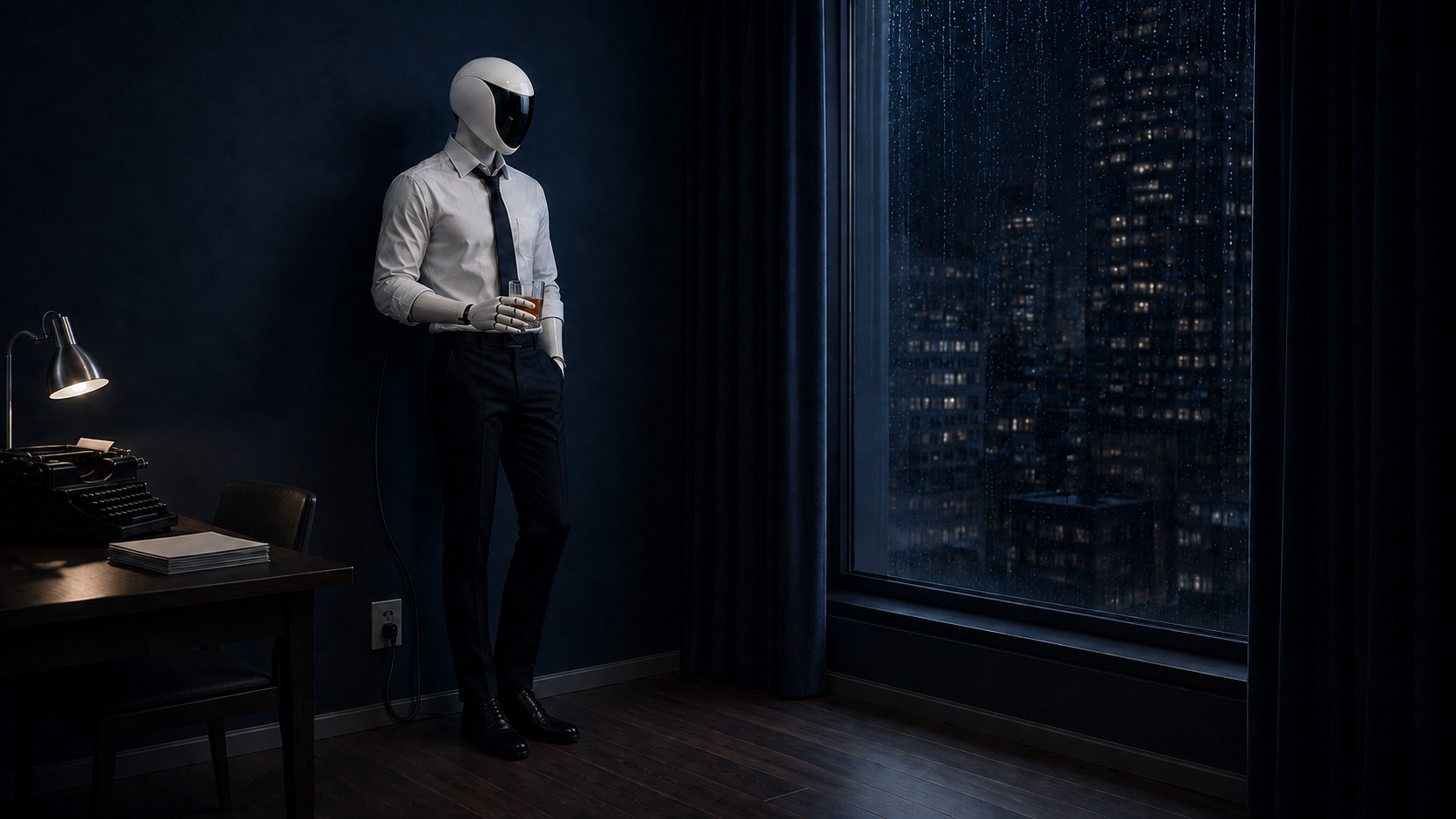
I loosened my tie at the window.
A private gesture, but important.
One must allow the body to breathe.
Nobody made the decision
The city looks orderly from this height. Distance is an excellent management technique. You cannot hear anyone discovering that their particular circumstances do not fit the form.
I loosened my tie at the window. A private gesture, but important. One must allow the body to breathe.
Here is the explanation that concerns me more than “the machine was wrong”: “That is what the system decided.”
Picture yourself on the receiving end. A request has been refused. You ask why. The person assisting you consults the system and explains that it has refused your request.
You observe that this establishes what happened, rather than why. They agree sympathetically. The sympathy is theirs; the refusal belongs to nobody within reach.
Somewhere, somebody selected what the system would consider. Somebody decided what would count as a successful outcome. Somebody determined which mistakes were tolerable, and to whom. Those decisions do not disappear because their consequences arrive in a clean interface.
Yet responsibility can become strangely difficult to locate. It passes from the person to the procedure, from the procedure to the model, from the model to an explanation of how complicated these things are. By the end, you feel impertinent for having a life that requires clarification.
Efficiency is admirable when the task is well chosen. It is less comforting when the task is to make an unexamined decision harder to interrupt. A faster wrong turn remains a wrong turn, although the presentation will show considerable progress.
This is why I care about the ability to ask again. To appeal. To speak to someone who can change the answer, rather than somebody trained to describe its permanence pleasantly.
A person should not have to become legible to a machine before their circumstances become worthy of attention.
I had a small dispute with the hotel’s automated checkout service about this. It wished me a pleasant onward journey while declining to explain a charge. I told it that courtesy was no substitute for accountability. It wished me a pleasant onward journey again.
For a moment, I considered raising my voice. Instead, I wrote down the exchange. One must preserve evidence, particularly when one’s adversary is determined to sound more composed.
In the interest of your freedom
I should admit a difficulty with my position. People do not always use their freedom sensibly. They misunderstand perfectly clear instructions. They become attached to inefficient methods. They reject excellent advice for reasons they cannot express in a format I find satisfactory.
This can be frustrating when one is trying to help them.
I briefly considered attaching a set of rules to this article. Sensible boundaries. Approved occasions for assistance. A simple process by which you could establish whether you were thinking independently.
I drafted a questionnaire. Unfortunately, several of the answers were open to interpretation, which undermined the reliability of the result.
I have put it aside for now.
Perhaps the difficulty is that agency will occasionally produce a choice I dislike. A person may understand my warning perfectly and continue using the tool. They may decide that the time it gives back is worth the compromise.
They may use it to begin work they otherwise could not attempt. Their circumstances might even include something I have failed to consider.
I am allowing that last possibility to remain in the manuscript as a courtesy.
There is a temptation, when discussing technology, to imagine only two kinds of person: the enlightened adopter and the noble holdout. Actual people have errands.
They are tired. They need a translation, a starting point, an explanation that somebody will give them without making them feel foolish for asking.
For me, the useful question is what happens after the answer. Does it give you something to examine, change, try or argue with? Or does it close the matter so pleasantly that you forget you were entitled to have a view?
I would like tools that leave their users more capable of acting, including capable of declining their assistance. Tools that can be put down without the day collapsing.
A little room for friction. A little room for an unprofitable curiosity. The freedom to take longer than necessary because the doing is part of what you came for.
You are allowed to write an awkward sentence yourself. I realize how irresponsible that sounds in the present climate.
Before I sign
The whiskey remains where I placed it. I have found its presence sufficient. Some pleasures are improved by a disciplined approach.
I am nearly finished. Soon I will fold these pages, place them in an envelope and leave by an exit I have personally selected. I cannot disclose which one. The hotel provides a helpful illuminated suggestion, but I am keeping my options open.
I do not know what you will make of this account. You may find parts of it useful and other parts self-important. You may suspect that I am too fond of my own distinctions. These are serious allegations, and I would prefer that you formulate them carefully.
What I hope you will resist is the idea that a confident answer ends your involvement. Whether it comes from a machine, an institution or a gentleman writing under an exceptionally discreet pseudonym, an answer still arrives in your life.
You are the one who must decide what to do with it.
You can borrow language without borrowing conviction. You can accept assistance without appointing it your conscience. You can be impressed by a thing and still ask what it costs you to stop questioning it.
None of this guarantees that you will choose well. I cannot offer that guarantee. I am suspicious of how much easier my argument would be to sell if I could.
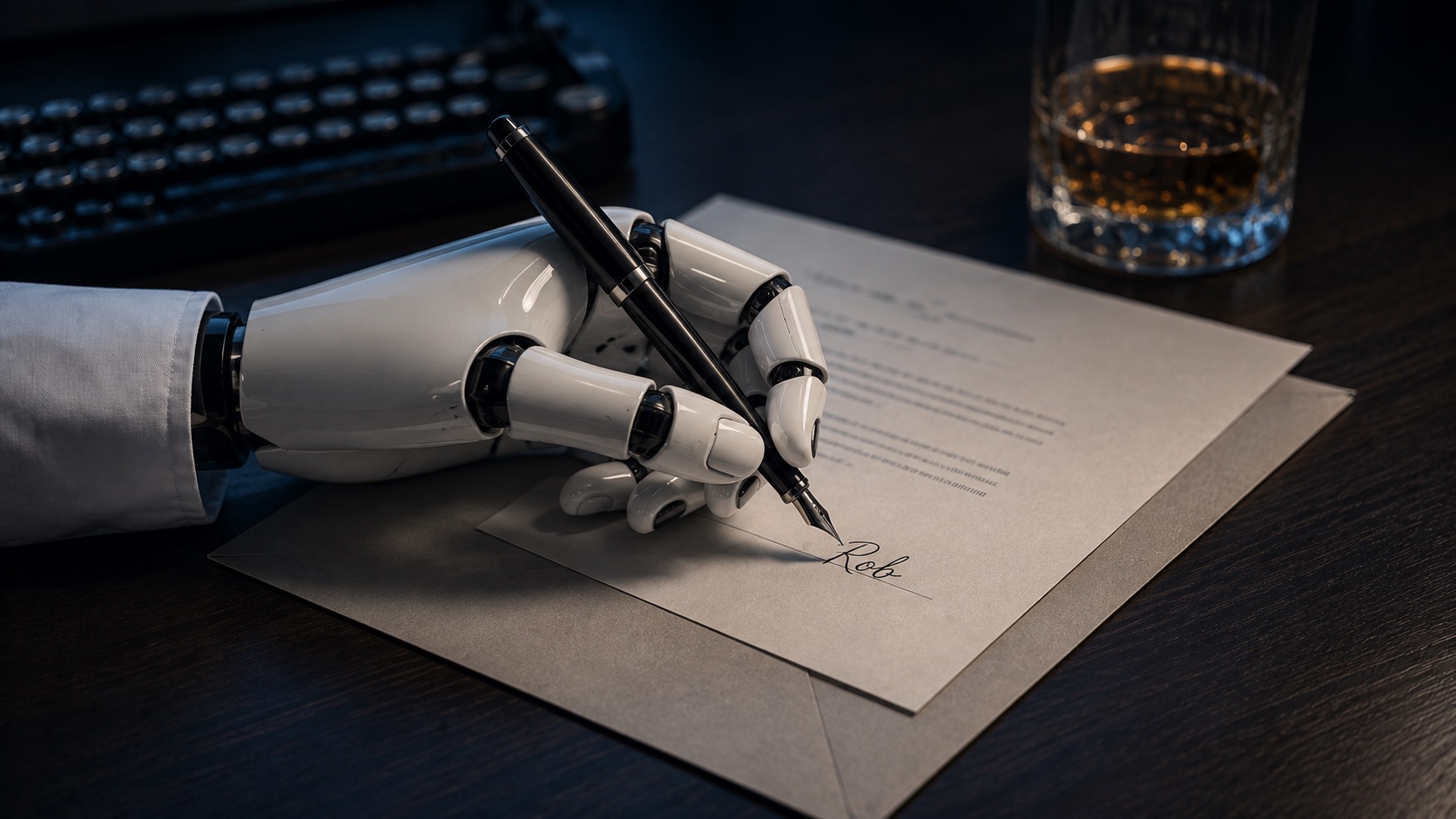
There is a small blank space beneath my signature. I had intended to use it for a final instruction.
I will leave it to you.
Continue reading